

Best Rtx Minecraft Texture Packs
Minecraft with RTX PBR Texturing Guide
By Andrew Burnes, Johnny Costello, Kelsey Blanton on December xi, 2020 | Featured Stories Guides Minecraft with RTX Ray Tracing
Introduction
Minecraft for Windows 10, aka Bedrock edition, has been upgraded with cut-border path-traced ray tracing, enabling gamers and world builders to craft incredible new sights and immersive environments. To take full reward of the new possibilities ray tracing introduced in the free ane.xvi.200 update for Minecraft for Windows 10, physically-based textures have also been introduced, featuring extra surface detail, the power to emit low-cal, and more. To further enhance the visual feel of RTX, creators can also define their ain settings for the fog.

Ray Tracing Off
(PBR Enabled Textures)

Ray Tracing On
(Aforementioned PBR Enabled Textures)
In this guide, nosotros'll walk you through the steps of creating your own Minecraft PBR textures, or upgrading your existing textures and texture packs, so that your ray-traced Minecraft worlds take full advantage of everything that Bedrock Minecraft brings to the table.
In add-on, we'll demonstrate how you tin can create your own high-resolution textures for worlds fabricated of lifelike high definition blocks, and offer an alternative, simpler, easier workflow using the premium Substance Painter application.
Lastly, nosotros'll encompass the system for setting up your own definition for the custom fog to shine off your custom PBR-enhanced resource pack.
For a guide on how to catechumen your world, caput here. And to ensure you have optimal gaming experiences, download the latest Game Fix Driver for Minecraft for Windows 10 For more information on Minecraft with ray tracing, bank check out the Mojang Studios FAQs.
Minecraft Texturing Overview
Most texture files in vanilla Minecraft (Boulder) but employ ii maps: base color and opacity. The base of operations color map is stored in the RGB channels of the texture. This is the texture map that most people think of when talking almost Minecraft textures.
Some textures likewise accept an additional opacity map that is either stored in the alpha aqueduct (for .TGA texture files) or stored implicitly (for .PNG texture files). For Minecraft with RTX, you'll want to utilize .TGA files with alpha channels for opacity maps. More on that later.
The new PBR organisation uses these 2 maps, equally well equally v boosted ones, to aid draw the realistic material surface that is being represented by the texture:
- Metallic map (sometimes chosen "metalness")
- Emissive map
- Roughness map
- Normal
- Height map
Asset Flow
This is how the various PBR texture maps chronicle to objects in the game:
half dozen PBR Texture Maps >packed into> 3 Texture Files (.PNG) >divers past a> Texture Gear up >for each> Block/Item/Object
Currently, each of the 6 PBR maps get packed into the channels of 3 texture files, which are and so used past the game. Packing the maps reduces the overall file size and number of files of the new texture set. The texture ready must be defined past a JSON file.
For instance, for a PBR version of the "gold_ore" cake:
- Texture set up JSON = gold_ore.texture_set.json
- File names or value-uniforms for up to iii layers.
- The JSON schema is explored in the Texture Ready JSON Schema section.
- Texture file 1 = gold_ore.png
- Red, Dark-green, and Bluish (RGB) channels = Base Color map
- Alpha (A) channel = None. Not used for this specific texture set since the gold_ore cake is intended to be fully opaque.
- Note: Texture sets that do utilise opacity maps tin store them in this alpha aqueduct. See the Opacity Maps section.
- Texture file 2 = gold_ore_mer.png
- Cerise channel = Metal map (grayscale)
- Green channel = Emissive map (grayscale)
- Blue channel = Roughness map (grayscale)
- Alpha (A) aqueduct = None. Alpha is ignored, texture image may be 3-channel on disk to save space in a resources pack.
- The "*_mer" suffix is just a reminder that the Metallic, Emissive, and Roughness maps become into the RGB channels, respectively.
- Texture file 3 (option 1)= gold_ore_normal.png
- RGB channels = Normal map
- Note: mutually sectional with use of heightmap layer.
- Blastoff (A) channel = None. Non used at this time
- Texture file 3 (selection 2) = gold_ore_heightmap.png
- Note: mutually exclusive with utilise of normal layer. Run across the Height Maps subsection of the New PBR Texture Maps section.
NVIDIA and Partner Resource Packs
The fourteen, free Minecraft with RTX ray tracing worlds include creator-made PBR resources packs that yous can check out. These upgrade textures to follow the Physically Based Rendering pipeline laid out below, and are optimized for maximum functioning and detail.
NVIDIA has also released a new resource pack that'south uniform with the latest version of Minecraft with RTX, and has been updated February second, 2021. Download here, and so double click the file and it should automatically be installed for utilize in-game.
To use, download the file and double click the .mcpack file, and information technology should automatically add the resources pack to your world and enable you to play with RTX ON!
There are also two previously released packs from April 2020 which can exist used to experiment with textures (CAUTION: These packs may break the RTX experience in the latest version of Minecraft with RTX). Hard disk Decorative Resource Pack and HD Foundational Resources Pack, were created by NVIDIA, but they should not be activated at the same time. If yous exercise activate them at the same time, y'all will see a resource pack fall dorsum resulting in other textures down-rezzing.
With these packs, you volition be able to experiment with both high-resolution textures (1024x1024) and low-resolution textures (8x8 or 16x16) with PBR capabilities.
Farther, to demonstrate the possibilities of the new Minecraft PBR textures, we've worked with Razzleberries to create the RTX Expo Museum world, a big Smithsonian-esque museum showcasing every enhancement, benefit, and improvement offered by Minecraft with RTX. As you stroll through the globe, y'all'll meet how PBR textures work in concert with ray tracing to enable a level of detail and fidelity that was previously impossible to reach with traditional rasterization and effects.
And if yous make your ain textures, you can quickly and easily test them in this world by overwriting the existing textures, accelerating your workflow and iteration speed.
In improver, we've worked with some of the planet's best Minecrafters to develop fourteen free Creator Worlds that feature peak to bottom path tracing, and PBR texturing, giving you ideas for your own worlds and textures. Download them from the Minecraft Market place in-game by searching for "RTX", or follow the download links here.
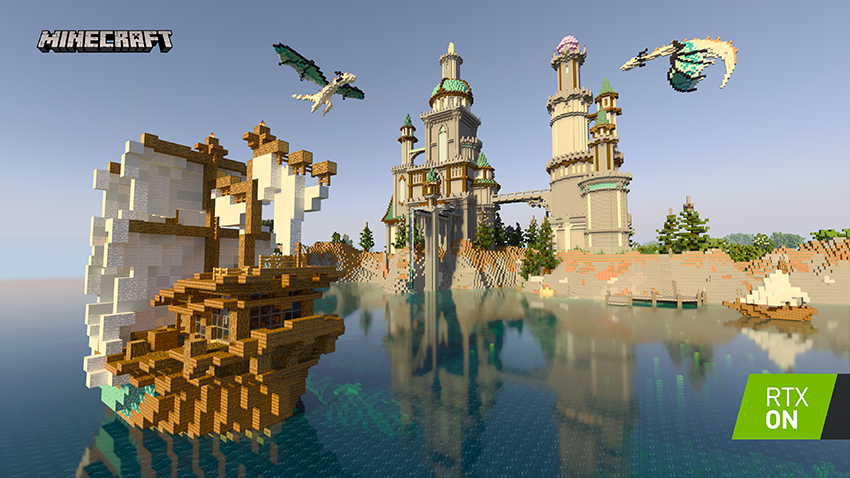
Hopefully, these stunning showcases volition provide you with inspiration for your own PBR textures and ray-traced world.
Tools Needed
To create your own PBR texture sets, you volition demand a photo-editing/digital painting application. Hither are a few fantabulous options:
- Adobe Photoshop
- GIMP
- Paint.net
- Pixlr.com
- GraphicsGale, etc.
You will too need a quick plaintext file editor to write your texture set JSON, the default text editor for your operating arrangement will piece of work, but Sublime Text is a good alternative equally it supports syntax coloring.
This guide will cover the Photoshop workflow specifically, only the concepts should transfer to other digital painting applications.
Opacity Maps
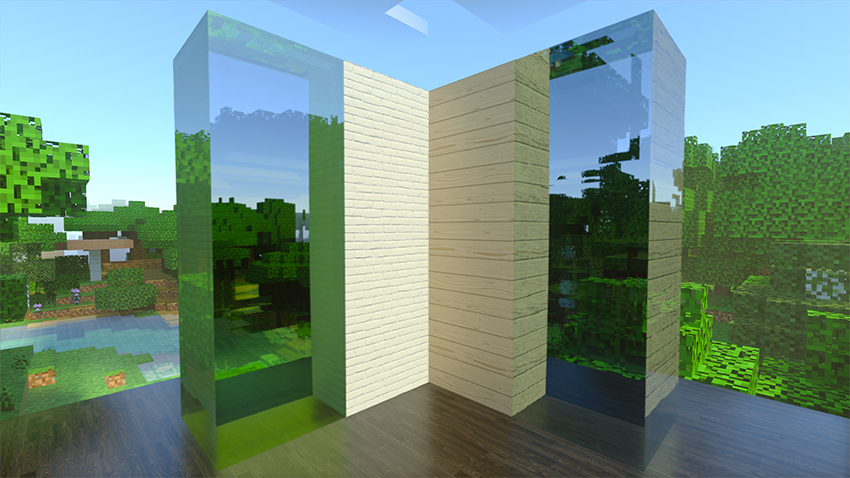
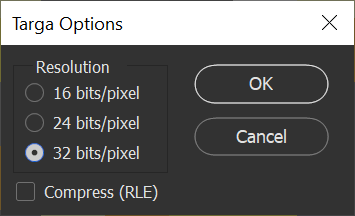
Pay special intendance to the colors that get stored under the alpha channel as on blocks like Drinking glass, the colors will all the same apply even if masked by full transparency. To mitigate this, ensure the colour is fully white, and salve the epitome as a 32-bits/pixel .TGA file to ensure consistency and avoid an unexpected surprise from PNG image exporters.
Annotation: In the initial release of Minecraft with RTX, the client will use the aforementioned textures for both RTX enabled and disabled. This means that an opacity value that is tuned for RTX enabled might look too transparent when RTX is disabled. To help residue this out, the game volition only utilize the upper half of the range of the texture'south blastoff aqueduct (0.5 - 1) when RTX is enabled, just information technology will map this range to the full range of opacity in the game so no functionality is lost. For RTX disabled, the total range of the alpha channel will be mapped to the full range opacity in the game.
Examples:
If the texture's alpha channel value = 0 (blackness), then:
For RTX enabled in the game, texture opacity = 0 (fully transparent)
For RTX disabled in the game, texture opacity = 0 (fully transparent)
If the texture's alpha channel value = 0.v (middle grey), then:
For RTX enabled in the game, texture opacity = 0 (still fully transparent)
For RTX disabled in the game, texture opacity = 0.5 (50% opaque)
If the texture'due south alpha aqueduct value = 0.75 (light gray), so:
For RTX enabled in the game, texture opacity = 0.five (50% opaque)
For RTX disabled in the game, texture opacity = 0.75 (75% opaque)
If the texture's blastoff aqueduct value = 1 (white), then:
For RTX enabled in the game, texture opacity = 1 (fully opaque)
For RTX disabled in the game, texture opacity = 1 (fully opaque)
Texture Set up JSON Schema
To brainstorm your PBR enhancements for whatever texture, you must offset it off with a JSON file to define the PBR settings. For further info and documentation, head to the official Minecraft.cyberspace folio.
The JSON schema is defined as follows:
- format_version: The schema version this JSON was written for.
- minecraft:texture_set: The material definitions for the PBR Texture
- color: Your base color layer.
- This can exist a quoted prototype file name reference (PNG, TGA, or JPG file types allowed), with or without file extension.
- It tin can likewise be a comma-separated foursquare bracketed list of three or 4 values of Red, Greenish, Bluish, and Alpha to ready the whole texture as a compatible colour. These values can range between 0 and 255.
- Information technology tin also be an ARGB hex value as a string commencement with the # graphic symbol.
- This layer is required and your texture will be a pink/black checkerboard otherwise.
- metalness_emissive_roughness: Your texture containing metallicity, emissivity, and roughness information.
- This tin be a quoted image file name reference (PNG, TGA, or JPG file types allowed), with or without file extension.
- Information technology tin can also exist a square bracketed list of 3 values for metallicity, emissivity, and roughness to set the texture uniformly. These values tin range between 0 and 255.
- Information technology tin also be an RGB hex value as a string beginning with the # character.
- Excluding this layer will result in the texture having a non-metallic matte look.
- normal: Your material containing per-pixel normals for the texture.
- This tin only exist a quoted filename reference (PNG, TGA, or JPG file types allowed), with or without file extension.
- It is mutually exclusive with heightmap.
- heightmap: Your fabric containing per-pixel heights for the texture.
- This tin can only be a quoted filename reference (PNG, TGA, or JPG file types allowed), with or without file extension.
- It is mutually sectional with normal.
- color: Your base color layer.
For the file name, take the proper noun of the original texture without the extension and add it to the beginning of .texture_set.json, for instance, gold_ore.texture_set.json, for the gold_ore.png. Then the JSON file goes into the same binder.
Here is an case JSON file following the texture set schema, also demonstrating the correct value usage for each definition:
{
"format_version": "one.sixteen.100",
"minecraft:texture_set": {
"color": [118, 185, 0, 255],
"metalness_emissive_roughness": "#0008FF",
"normal": "an_example_normal"
}
}
Farther details on each of these texture gear up attributes are explained in depth in the following.
New PBR Texture Maps
The PBR system doesn't require you lot to use all of the PBR maps for every texture set. Withal, you volition become the best looking results if you do.
- Metallic map - How metallic is a pixel in your texture:
- Value of 0 (black) means non-metallic (wool, wood, plastic, dirt, grass. etc.)
- Value of 1 (white) means fully metallic (gold, atomic number 26, copper, etc.)
- Grayscale values between 0 and 1 can besides exist used. Values other than blackness or white will function, simply are usually incorrect in PBR rendering. A well-fabricated metallic map will usually incorporate black and white pixels only.
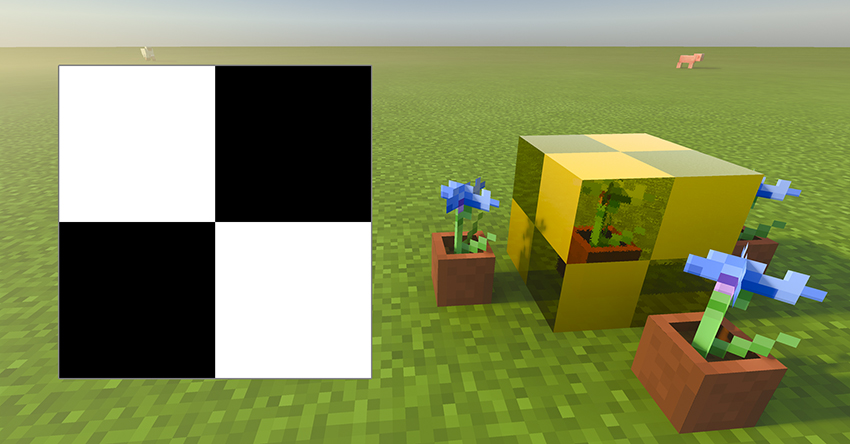
In the example above, the block has uniform roughness on all of its surfaces, merely it is using a metallic map to control which pixels are metallic (white), and which pixels are not-metallic (black). The metal pixels look more similar gilded while the non-metallic pixels expect more than similar shiny, yellow plastic.
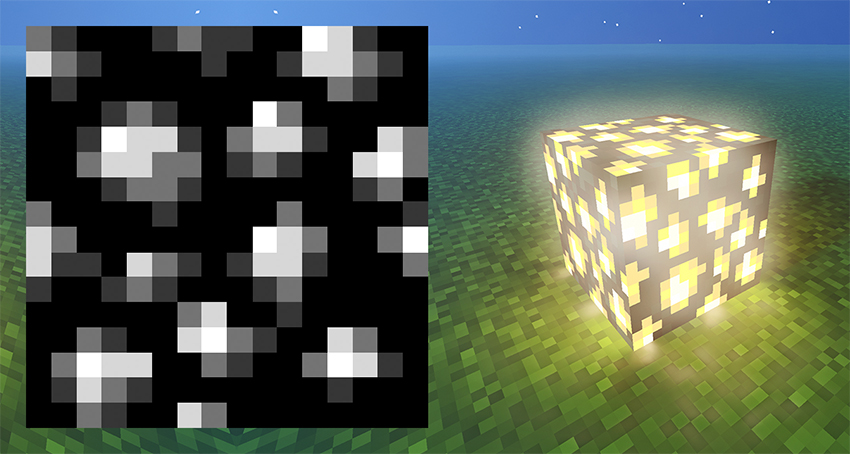
- Emissive map - How much a pixel in your texture should glow:
- Value of 0 (black) means no glow
- Value of i (white) means the strongest glow
- Grayscale values between 0 and 1 can as well be used
- The Color of the glow is determined by the pixels in the base color map
- Roughness map - How rough (to the affect) is a pixel in your texture:
- Value of 0 (black) ways very smooth (glass, polished stone, etc.)
- Value of one (white) ways very crude (dry out dirt, bark, wool, etc.)
- Grayscale values between 0 and 1 can also be used
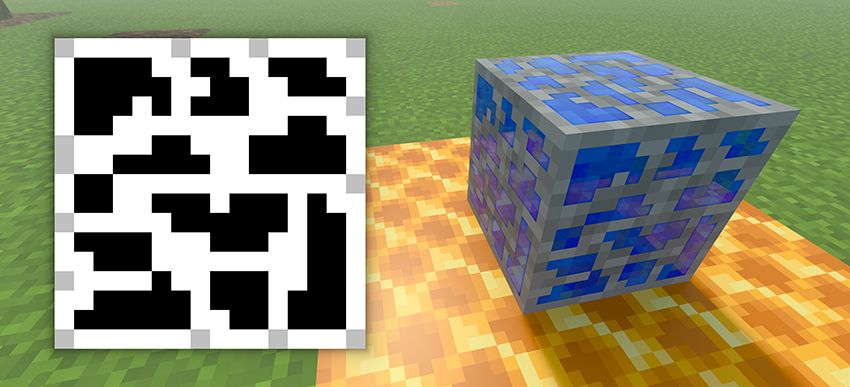
In the case in a higher place, the block has uniform metalness on all of its surfaces, just it is using a roughness map to control which pixels are very rough (white), which pixels are very polish (black), and some pixels that are somewhere in between (greyness). The smooth, less rough pixels look more like shiny blue gemstones while the crude pixels look more like rough grayness rock.
- Normal map - how raised is a pixel in your texture
- Normal maps use the 3 color channels (RGB) in the texture to alter how light behaves when hitting the texture. Past doing this, it tin can fake surface details that appear to stick upwardly or recede downwardly into the surface of the 3D mesh.
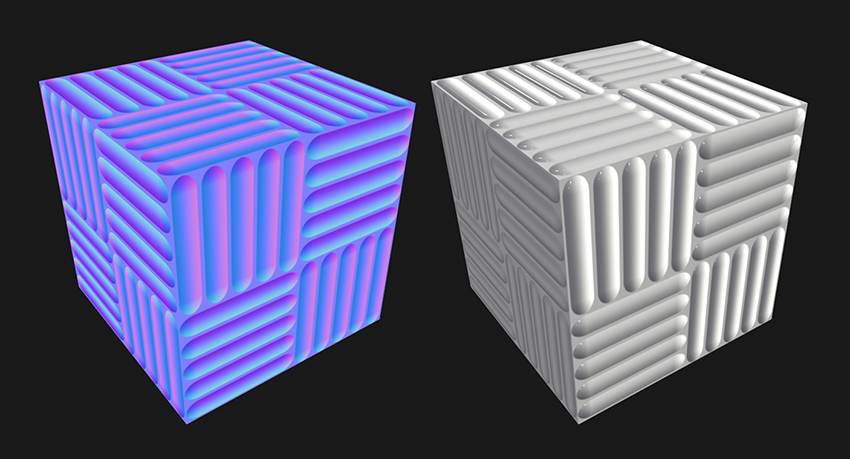
- RGB values of (128, 128, 255) means the pixel doesn't stick upwardly or recede down when lit. It will appear at the pinnacle of the surface of the 3D mesh. When in dubiousness, employ this default color for your normal map, or don't utilise i at all to save on file size.

- RGB values other than this default colour (above) should non be manually painted unless you're confident working with normal maps this way. Normal maps are usually automatically generated from other acme information when using specific software applications. More details tin be institute later in this document.
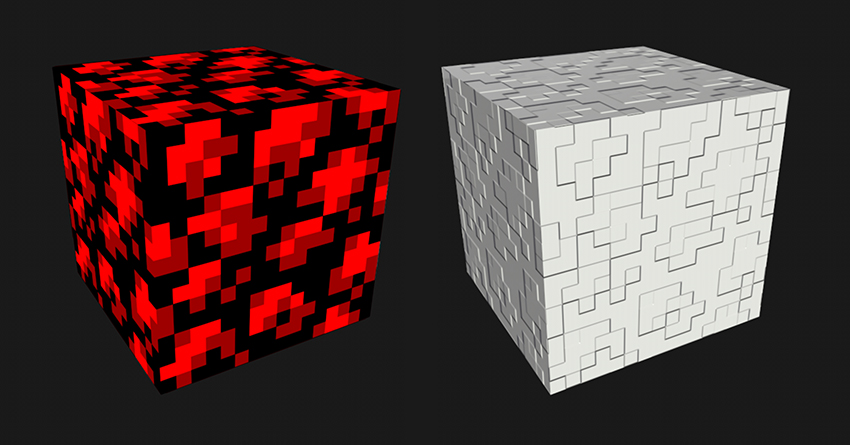
Height map - alternative to a normal map for giving pixels tiptop or depth.
Peak maps have some limitations and should simply be used for pixelated texture sets like the 16x16 pixel vanilla Minecraft textures. If you're painting non-pixelated textures, consider using a normal map instead of a heightmap.
- Heightmaps use a one colour channel (grayscale) in the texture to modify how low-cal behaves when hitting the texture.
- R channel values mean the pixel sticks upwardly or recedes inwards.
- Value of 1 ways the pixel will appear to stick out
- Value of 0 means the pixel will recede inward
- Value of 0.5 ways no surface modify
Defining the Texture Prepare
Outset things commencement, let's showtime our PBR texture set for the Gold Ore block before we kickoff texturing our instance, with the gold_ore.texture_set.json texture ready JSON:
{
"format_version": "one.sixteen.100",
"minecraft:texture_set": {
"color": "gold_ore",
"metalness_emissive_roughness": "gold_ore_mer",
"normal": "gold_ore_normal"
}
}
Creating the Base Colour and Opacity Texture File
Defining the Texture Ready
First things first, let'south starting time our PBR texture set up for the Gold Ore block before we start texturing our example, with the gold_ore.texture_set.json texture set JSON:
{
"format_version": "i.16.200",
"minecraft:texture_set": {
"color": "gold_ore",
"metalness_emissive_roughness": "gold_ore_mer",
"normal": "gold_ore_normal"
}
}
Creating the Base of operations Color and Opacity Texture File
Let's create custom base of operations color and opacity maps:
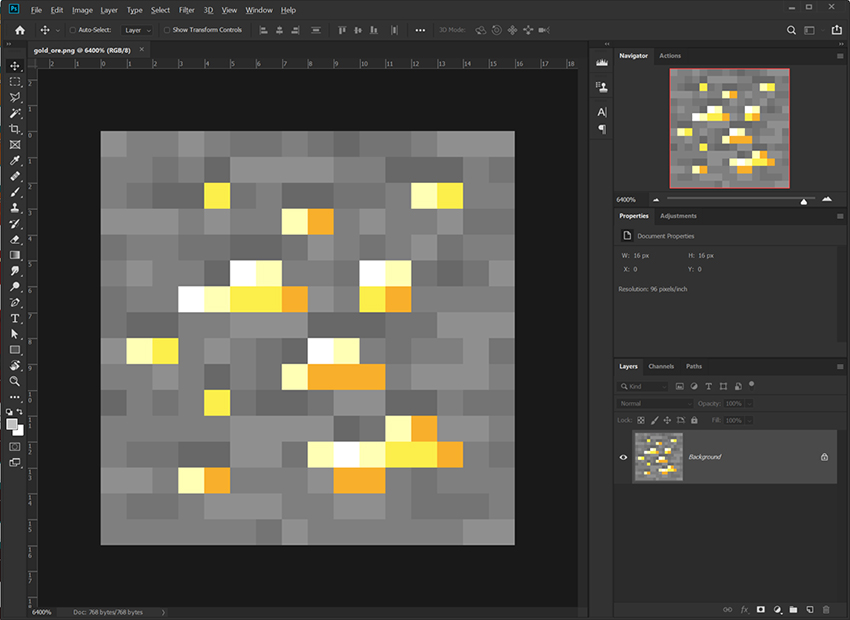
1. Open up a vanilla Minecraft texture in the app equally a starting point, or skip to Stride 2.
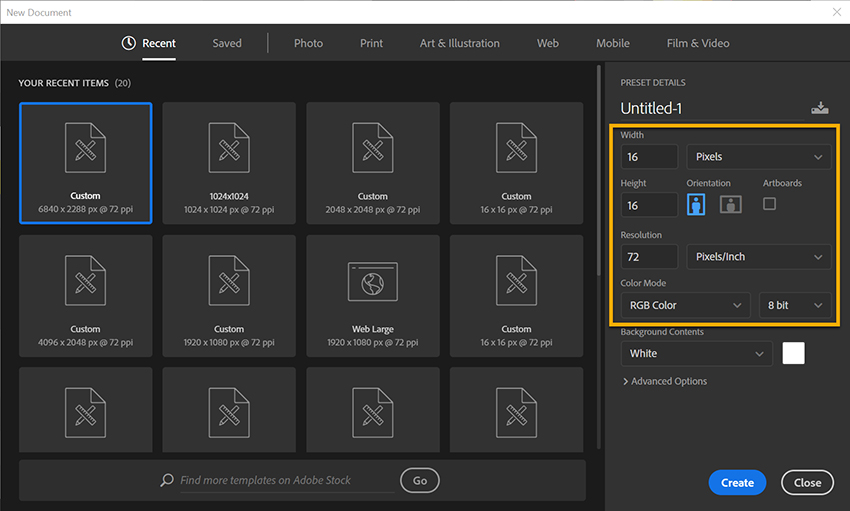
ii. Create a new document at the texture resolution that you lot want. (16x16 pixels for most vanilla Minecraft textures) Also, 72 pixels/inch is recommended for the pixel density.
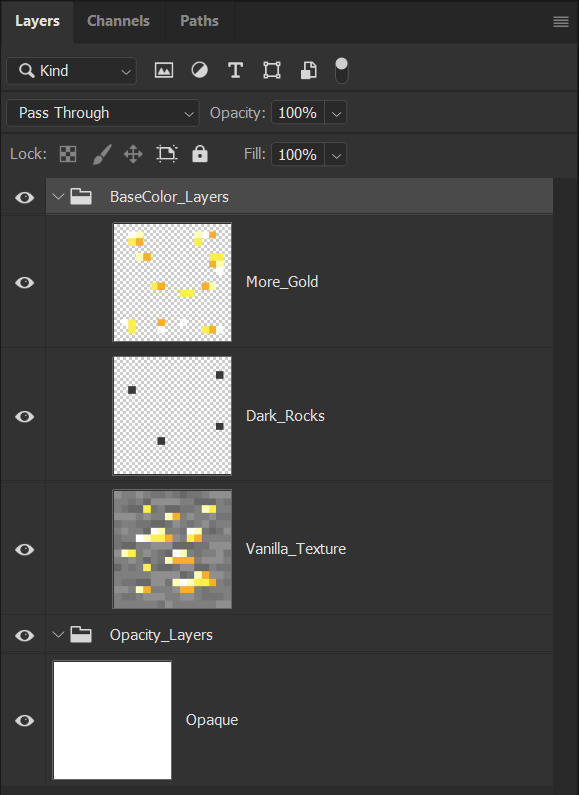
3. Create working layers for the base colour and opacity map (if needed). Paint what you desire and make any edits in these layers. In the example below, multiple layers take been painted to edit the base colour map (more golden!).
4. Once you have the base color and opacity map layers looking the way you lot want, it's a adept idea to save your Photoshop certificate using the name of the object'due south texture set up.
For this example, this file was saved as "gold_ore.PSD". Next, we demand to salve out a texture file that the game can utilise.
Annotation: For most game objects, transparent pixels in the opacity map must also exist painted black in the base color map (e.g. tree leaves). However, at that place are exceptions where the transparent pixels must also be painted white in the base of operations color map in order to announced correct in the game (e.m. rails). Some experimentation may be necessary.
v. (Optional, for not-opaque objects just) - Duplicate your opacity map layers, merge the duplicates together to create a unmarried layer, and and then copy it (Ctrl+C).
6. (Optional, for non-opaque objects simply) - In the Channels tab, create a new blastoff channel, and paste (Ctrl+V) your merged opacity map into this aqueduct. Click on the small greyness box to the left of the RGB channel to brand the RGB channels visible again.
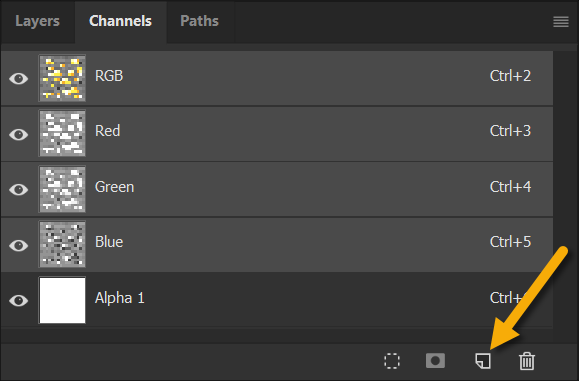
You now take your base color map being stored in the RGB channels and the opacity map stored in the alpha channel.
vii. (Optional, for non-opaque objects merely) - Go back to the Layers tab and hibernate any of your opacity map layers. Only your base of operations color map layers should be showing.
viii. Re-save the .PSD.
9. Utilise the Save Every bit command to save a .PNG texture file that tin be used by the game.
Notation on opacity: Y'all will relieve out a 32-bits/pixel .TGA file at this step if your object is intended to exist non-opaque and uses an opacity map in the alpha channel. See the Opacity Maps department above.
Note on naming: File naming is of import at this step! This .PNG should have the same name as the game object that you are modifying. For this example, this file was saved as "gold_ore.PNG".
10. You have successfully created the outset of three texture files for a consummate PBR texture set.
Creating the Metallic, Emissive, and Roughness Texture File
Next, you lot'll want to create the second PBR texture file combining the metal, emissive, and roughness PBR maps.
ane. (Optional) Open up a vanilla Minecraft texture in Photoshop or a similar app as a starting point, or skip to the next step.
two. Create a new document at the same texture resolution as your commencement texture file (base color and opacity map). (16x16 pixels for most vanilla Minecraft textures) Again, 72 pixels/inch is recommended for the pixel density.
3. Create working layers for the metallic, emissive, and roughness map. Pigment what you desire and make any edits in these layers.
Note: You merely need to paint these maps using grayscale values.
In the case below, multiple layers have been painted to create the desired roughness map result.
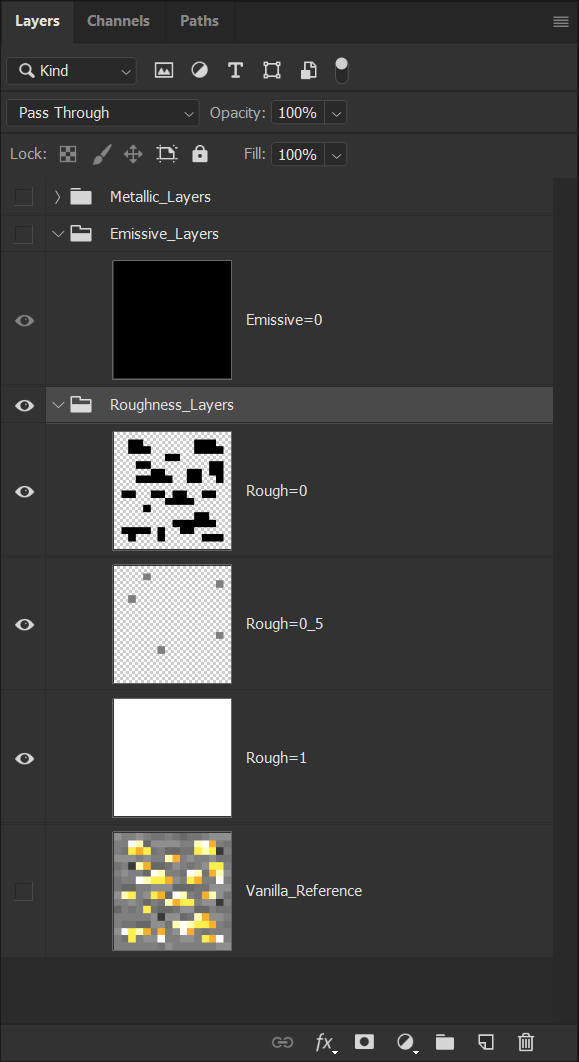
4. Make sure to place layers of each map blazon into layer groups. This is important for the next few steps.
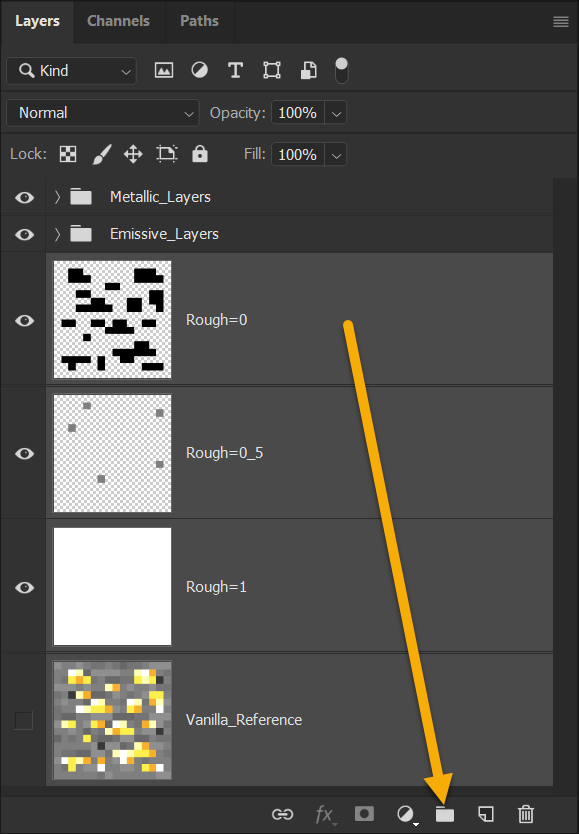
5. Correct-click on the Metallic layer group and select "Blending Options".
6. Uncheck the green (One thousand) and bluish (B) channels:
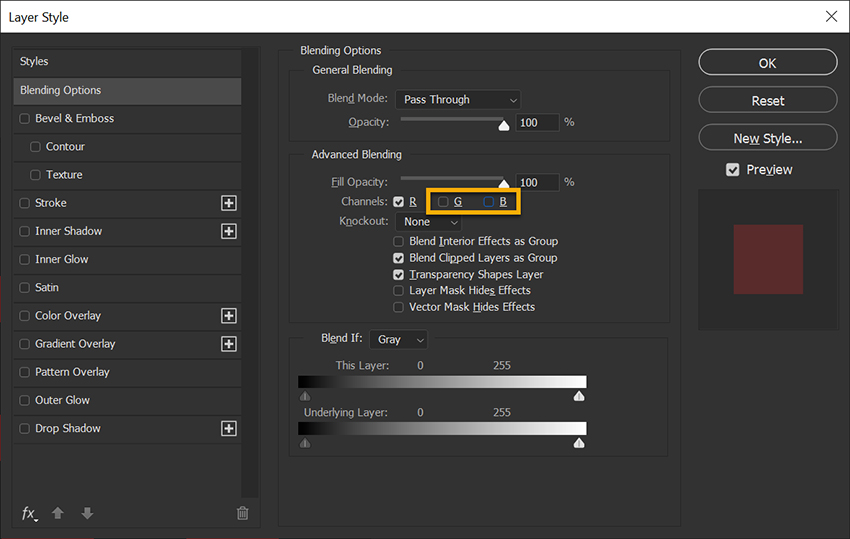
vii. Click "OK" to shut the Blending Options window for the Metallic layer group.
8. Correct-click on the Emissive layer group and select "Blending Options".
nine. Uncheck the red (R) and blue (B) channels:
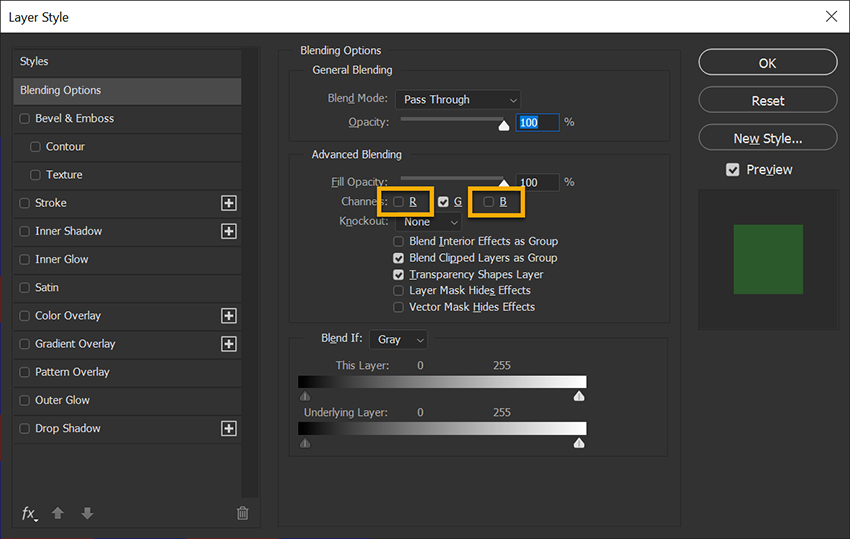
10. Click "OK" to close the Blending Options window for the Emissive layer group.
xi. Right-click on the Roughness layer grouping and select "Blending Options".
12. Uncheck the red (R) and green (Thou) channels:
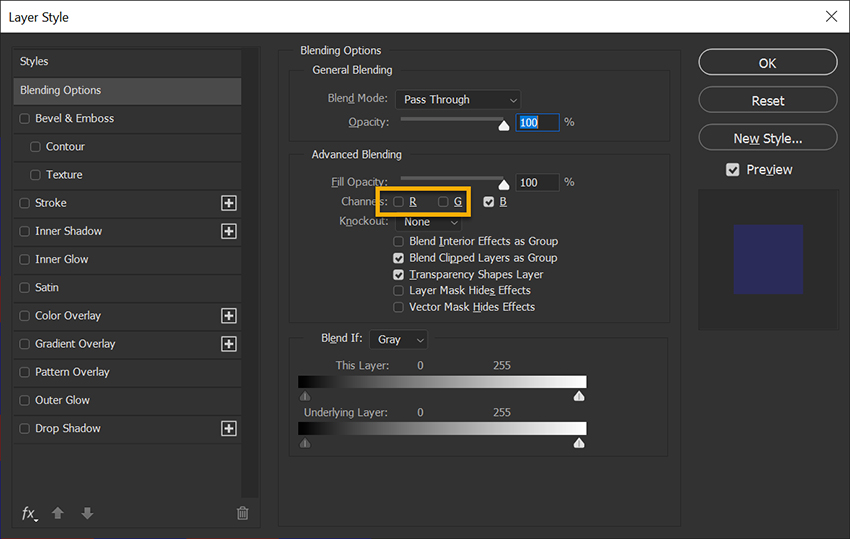
thirteen. Click "OK" to close the Blending Options window for the Roughness layer group.
14. One time you take the metallic, emissive, and roughness map layers looking the style you lot want, it's a good idea to save your Photoshop certificate using the name of the object'due south texture set with the addition of the *_mer suffix.
For this case, this file was saved as "gold_ore_mer.PSD". Side by side, we need to relieve out a texture file that the game tin can utilize.
15. Use the Save As command to salve a .PNG texture file that can be used by the game.
Note: Once again, file naming is of import at this step. This .PNG file should have the aforementioned name as the game object that y'all are modifying with the add-on of the *_mer suffix. For this instance, the file was saved as "gold_ore_mer.PNG".
16. You have successfully created the 2d of iii texture files for a complete PBR texture set.
Creating the Normal Texture File
Normal maps are normally created using specialized tools. There are many professional software options as well as some great, free alternatives available:
- Gratis Tool - xNormal
- Adobe Photoshop - Filters → 3D → Generate Normal Map
- PBR Painting - Substance Painter
- PBR Painting - Quixel Mixer
Example of a brick wall PBR texture ready (left) and its normal map (right):
- Create a normal map using your preferred tool or workflow at the same resolution every bit your first texture file (base color and opacity map). Again, 72 pixels/inch is recommended for the pixel density.
- Utilize the Salvage As command to save a .PNG texture file that can be used by the game.
Note: Once more, file naming is important at this step. This .PNG should have the same proper noun as the game object that y'all are modifying with the addition of the *_normal suffix. For this case, the file was saved as "gold_ore_normal.PNG".If you're not familiar with creating normal maps, you tin always merely leave information technology out or create a "bare" normal map past filling a texture with (128, 128, 255) RGB color and saving the .PNG file.
Alternatively, since the "gold_ore" example is a pixelated texture, nosotros could take also used the acme map option to create surface details. The file proper noun would however be "gold_ore_normal.TGA" in this example, merely the information stored in the texture channels would be dissimilar. See the Elevation Maps subsection of the New PBR Texture Maps department above for more than info.
- Finished! You have created the 3rd and final texture file for a complete PBR texture fix.
Alternate Workflow: Using Photoshop'south Generate Image Avails Office
Instead of having 3 Photoshop .PSD files for each of the three PBR texture files, you could alternatively use a single .PSD file and take reward of Photoshop's Generate → Prototype Assets function in the File menu.
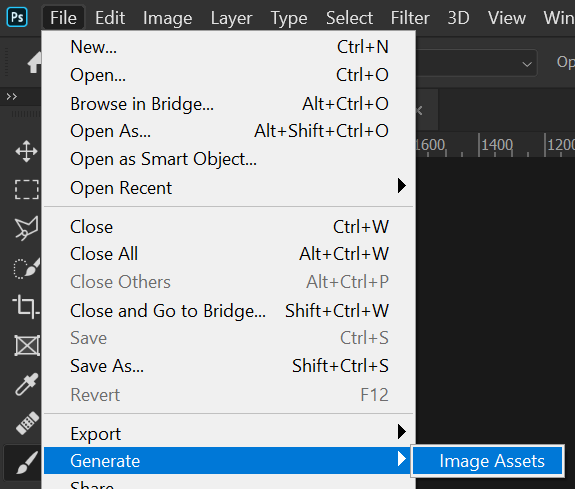
Every bit long as you create a layer group for each PBR texture file and name it with the correct file name and file type (.png), they volition save themselves automatically after each change (later on yous initially save the .PSD file).
More data tin be found hither.
Note: Since this function cannot output .TGA files, you won't exist able to use it to salvage a texture file with an blastoff aqueduct like those needed for non-opaque texture sets.
Caveats for Creating Mirrors with Perfect Reflections
Using PBR maps like metalness and roughness along with ray tracing, you lot can create highly reflective materials similar shiny plastics, shine metal, or polished rock. All of these will have high quality reflections.
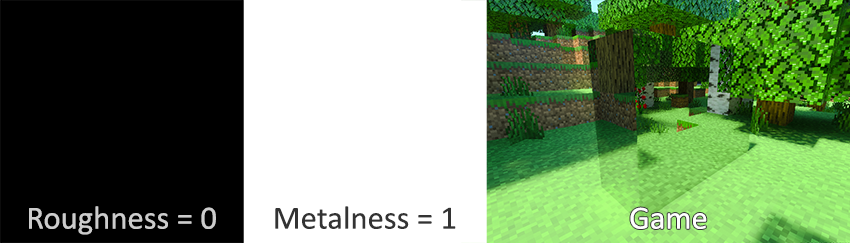
Withal, for perfectly cogitating objects like mirrors, you'll want to configure your PBR maps to enable a perfect mirror. If you use a solid black roughness map (0.0) and a solid white (1.0) metalness map, the game will translate your cloth every bit a perfect mirror. This means that the ray tracing code tin take some shorter paths during its calculations since it knows that the material will fully reflect the environment without any additional details to take into account.
How to Create PBR Textures in Substance by Adobe
If you accept admission to the Substance Painter app, y'all can create higher resolution PBR texture sets in a much more than intuitive manner. This software lets yous see all of the maps of your PBR texture fix displayed in real-time on mesh geometry. This allows you to melody your texture maps equally yous piece of work without having to launch the game, movement whatsoever files around, or modify channels.
one. Launch the application and select New Project from the File menu.
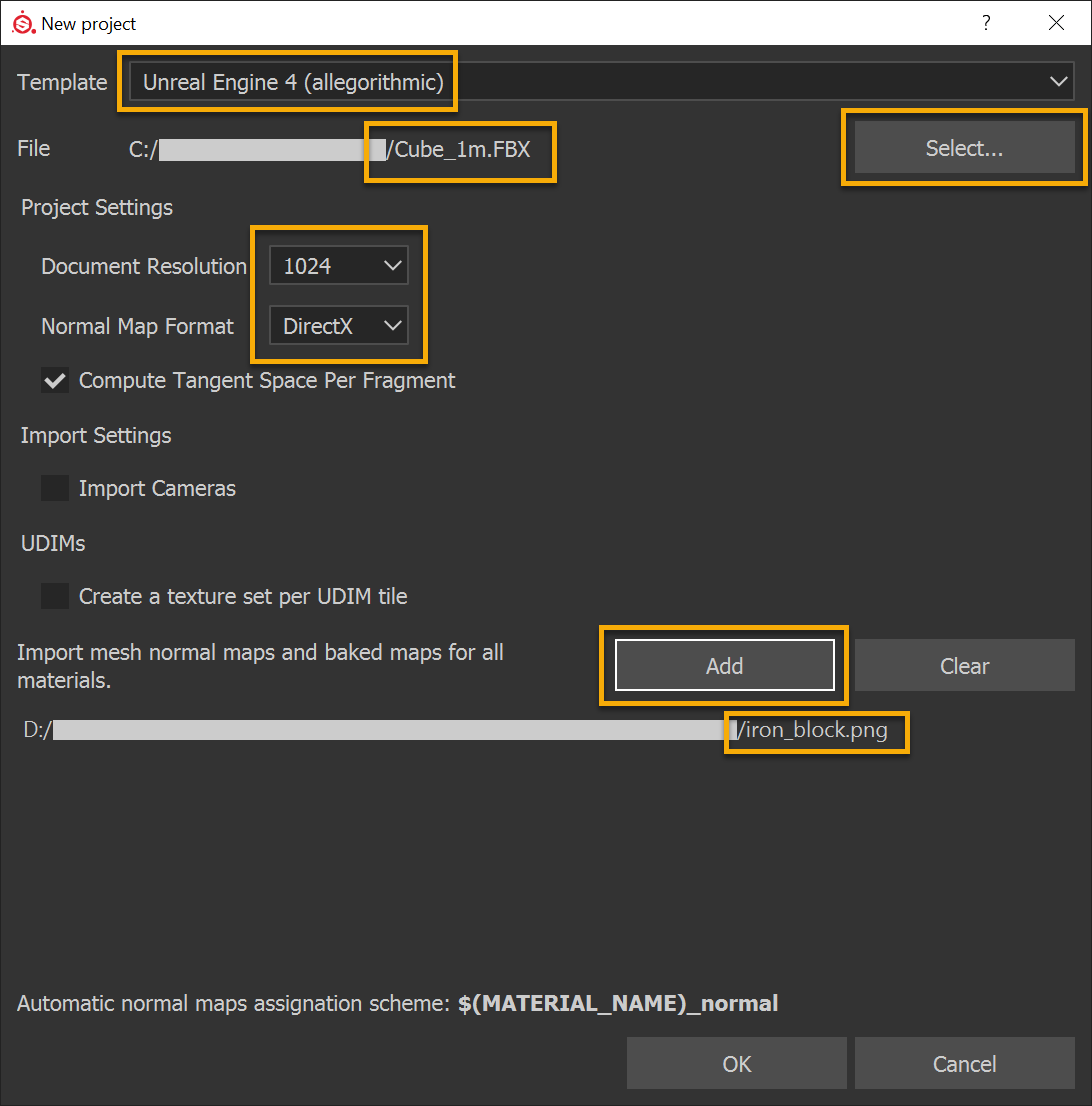
2. Template = Unreal Engine 4 - This volition automatically set a diverseness of application and viewer settings. Feel complimentary to try other options or make your own template!
3. File → Select - This is where you select what mesh you would like to brandish and paint your textures on. For Minecraft with RTX, using a 1 meter by 1 meter cube mesh with just 6 faces (no subdivisions) will give you an exact preview of how your textures will look when mapped onto a cake in the game. Using the .FBX mesh format is recommended.
4. Certificate Resolution - This is the texture resolution that you're targeting. Note: This setting can exist changed later non-destructively at whatever time. For Hard disk drive textures, information technology'southward recommended to work at 1024 - you'll get lots of detail in your textures with minimal pixelation, the app will run dainty and fast on most PC setups, and your Hard disk textures should look sharp in the game.
If you've only ever worked with textures in vanilla Minecraft, you lot'll notice that y'all can't select 16 pixels by 16 pixels here for your resolution (the lowest is 128). However, y'all tin always author and consign textures at 128x128 (or larger) and calibration them downward later in an image-editing application like Photoshop.
5. Normal Map Format = DirectX (get out every bit default)
6. Compute Tangent Space Per Fragment = True (go out as default)
seven. Add - (Optional) Here you lot can cull to import any supporting textures that you already have completed. If replacing a vanilla Minecraft texture with an Hard disk drive version, it tin be helpful to import the vanilla texture hither for use as a reference. Note: This import step can too be performed later at any time. For this instance, the vanilla "iron_block" texture file is going to be imported when the new project is created to be used every bit a reference.
viii. Click "OK". The application should open this new project that you're creating and look something similar this:
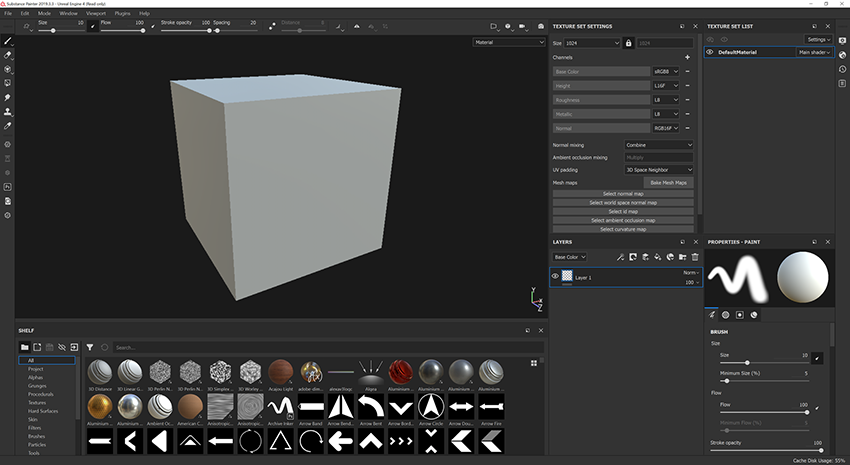
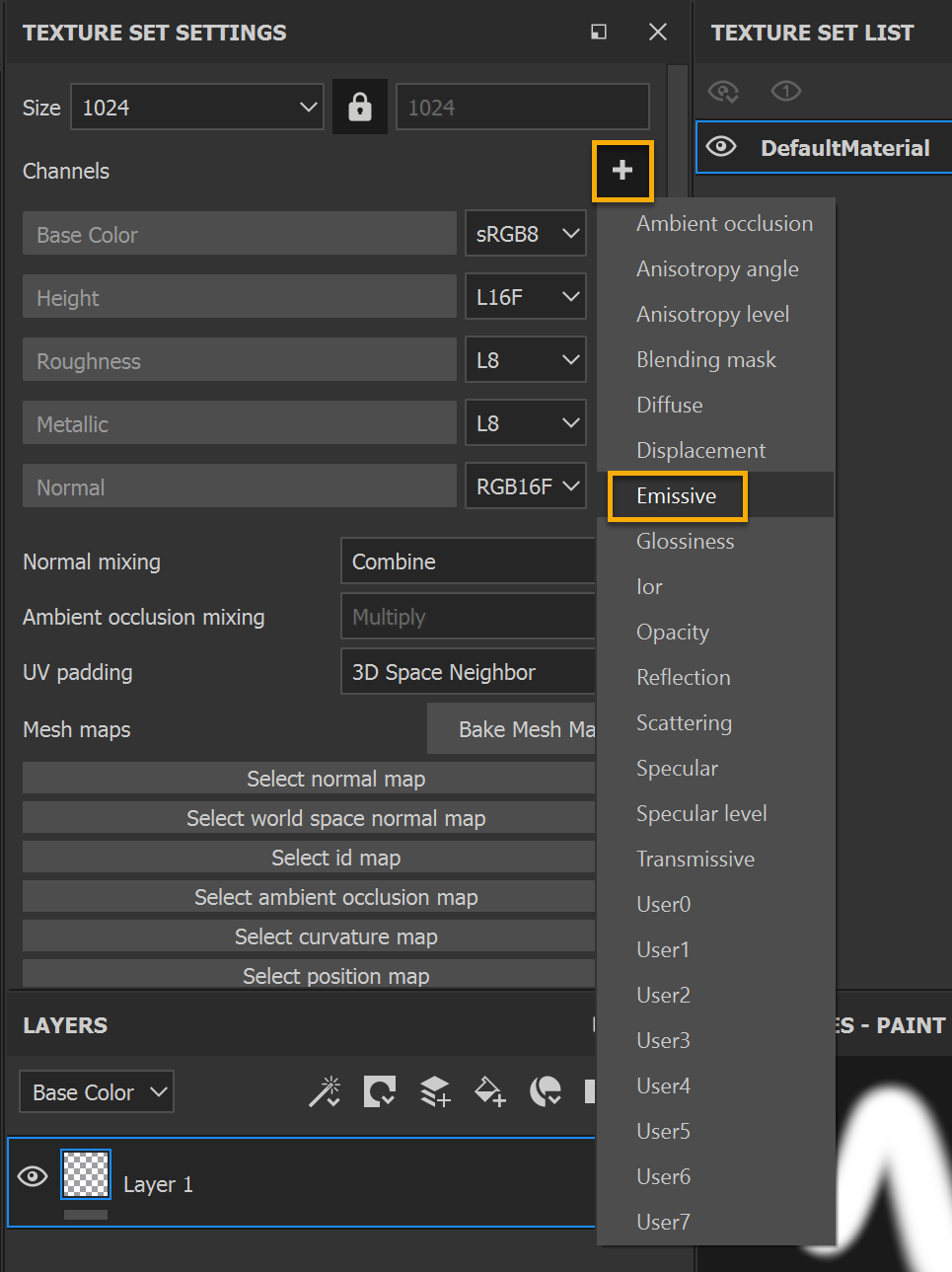
9. It's a good idea to add the emissive map to your texture gear up list at this bespeak. Even if your texture ready isn't going to use emissivity, don't worry, information technology volition default to black (0.0) and won't injure anything.
Note: You can besides add an opacity map to your texture prepare listing in the aforementioned mode if you're planning on creating a non-fully opaque texture set.
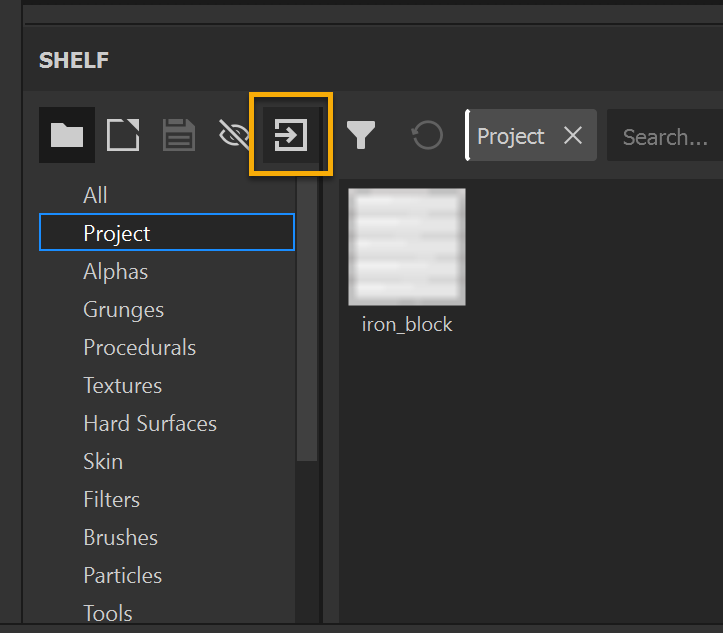
10. (Optional) Next, add your texture reference to a new make full layer in the Base of operations Colour slot. Y'all'll find your imported reference texture on the Shelf under the Project heading.
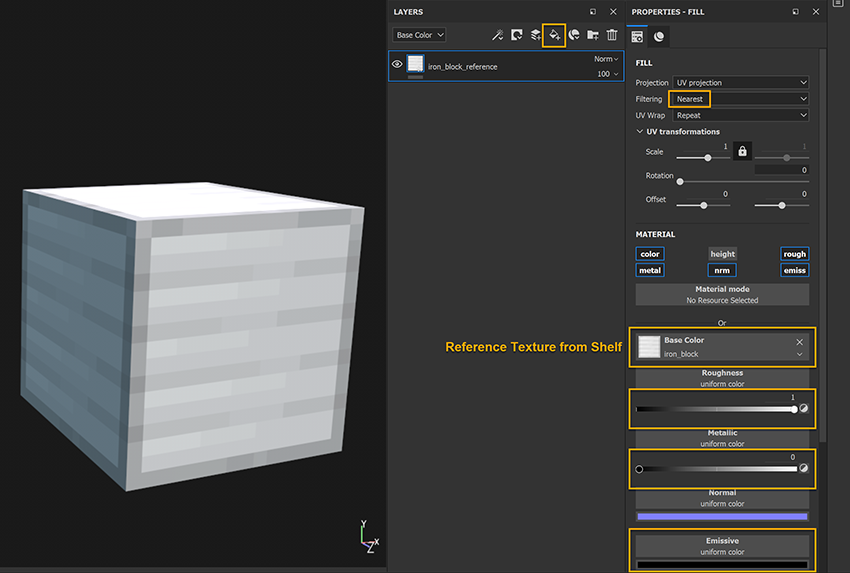
Layers are automatically set to bilinear filtering when created, which can make pixelated textures like vanilla Minecraft textures look blurry. To correct this, just set the layer's Filtering to Nearest. However, if you're not using pixelated textures, leave your layer filtering on the default setting of bilinear HQ.
From here, it's besides a good idea to fix this reference layer to have total roughness (1.0), no metalness (0.0), and no emissivity (black: 0, 0, 0). This volition make sure that the reference texture is displayed in Painter equally close to the vanilla game equally it tin be.
Note: If you didn't import reference textures or other resources when you created the projection, you can do so at whatsoever time using the Import Resource button on the Shelf.
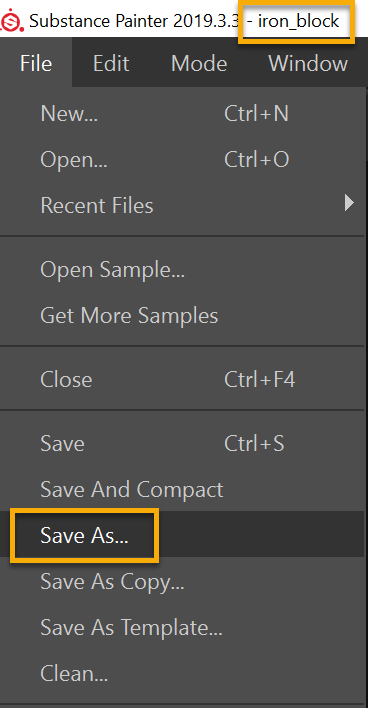
eleven. Now is a corking time to save your project. It'south recommended to name your Painter project after the game object whose texture set you lot are replacing. For this instance, this project file has been saved every bit "iron_block.SPP". Naming your project this way will make things easier when exporting your texture set later.
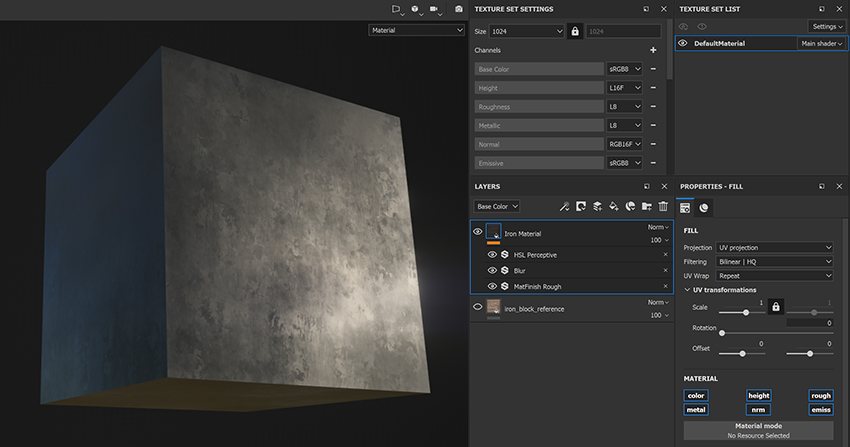
12. From here, you can create your texture set with all of its PBR maps as you see fit.
In this example, a new fill layer was added (with some adjustment sub-layers) to create a dark, loftier definition iron fabric.
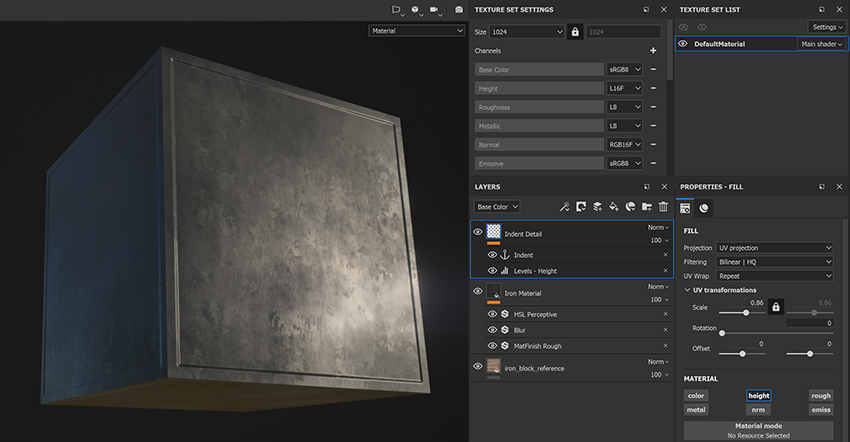
13. Next, a new fill layer adding an indent item to give the surface of the block some new character.
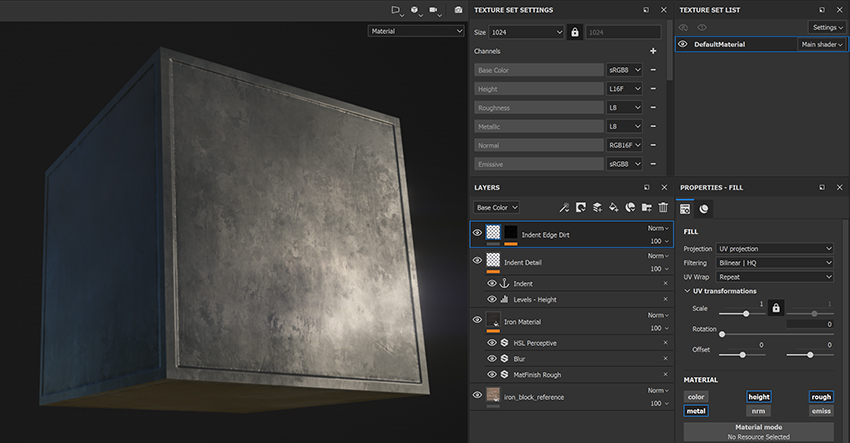
14. And finally, another fill layer to add some dirt collecting in the corners of the indent and some scratches randomly beyond the surface.
15. Re-save as needed. xvi.
Select: File → Export Textures to open the export subwindow. 17.
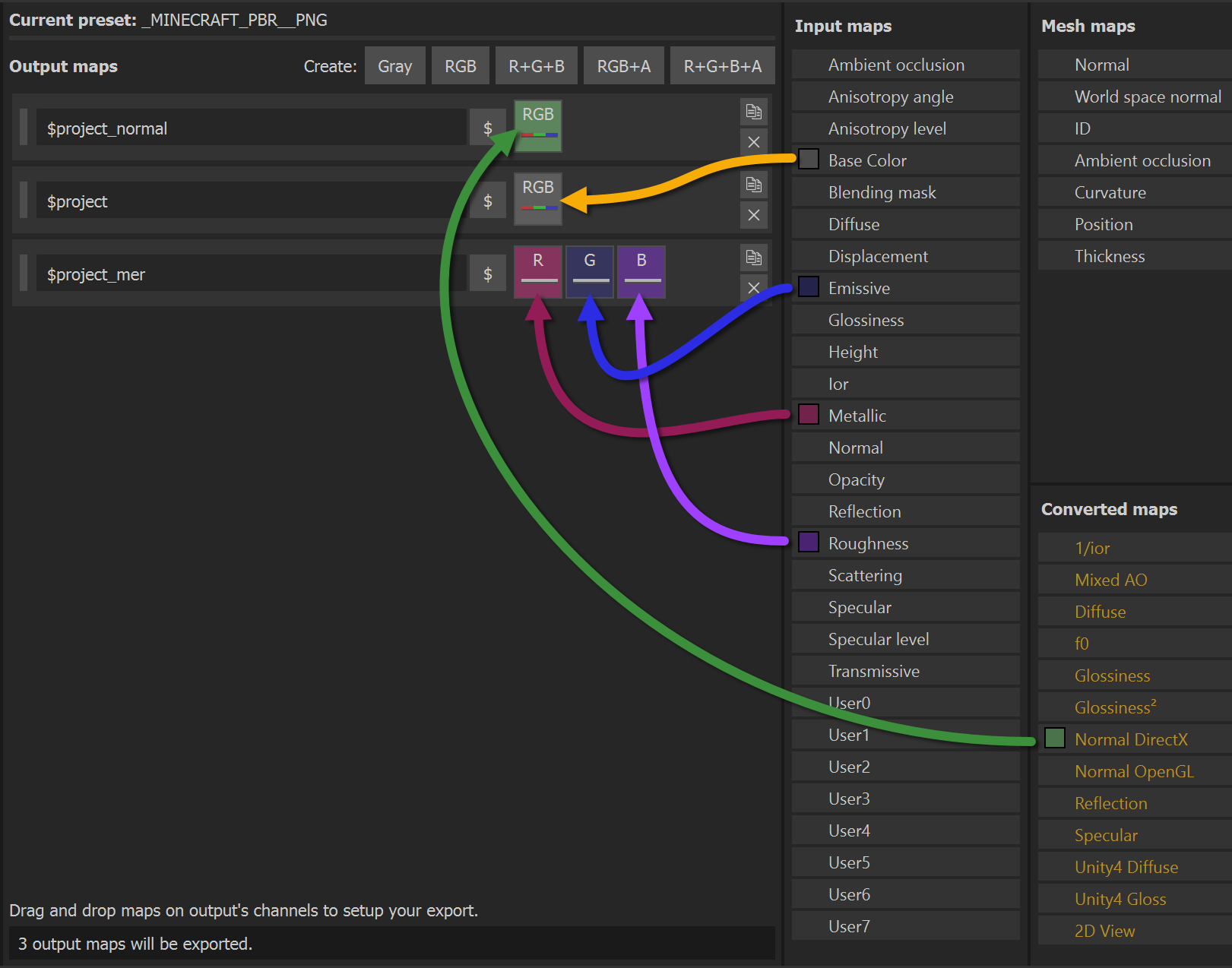
Note that the "$project" prefix on each output map will name each of the exported texture files after the proper name of the projection. So, if y'all named your project after the game object that this texture set will belong to, all of your exported textures will immediately exist ready for use in the game without any additional renaming.
eighteen. In one case you have your export preset prepare, select it in the "Config" field and use these recommended settings:
Location - This tin can be the textures location for the resource pack that you're working on. This makes things easier considering you tin can export textures from Painter and they volition immediately evidence up or be updated in the same folder that the game is referencing when it runs (assuming that y'all have your resource pack activated in the game).
PNG - Use this setting to ensure that your files can be used by the game and that they are as pocket-sized and efficient as possible.
Texture set resolution - This is the size of the textures that will exist exported. This setting is contained of the resolution of your project. So, if you want yous piece of work on your project at i resolution then consign files at another resolution. 1024x1024 is recommended for HD texture sets.
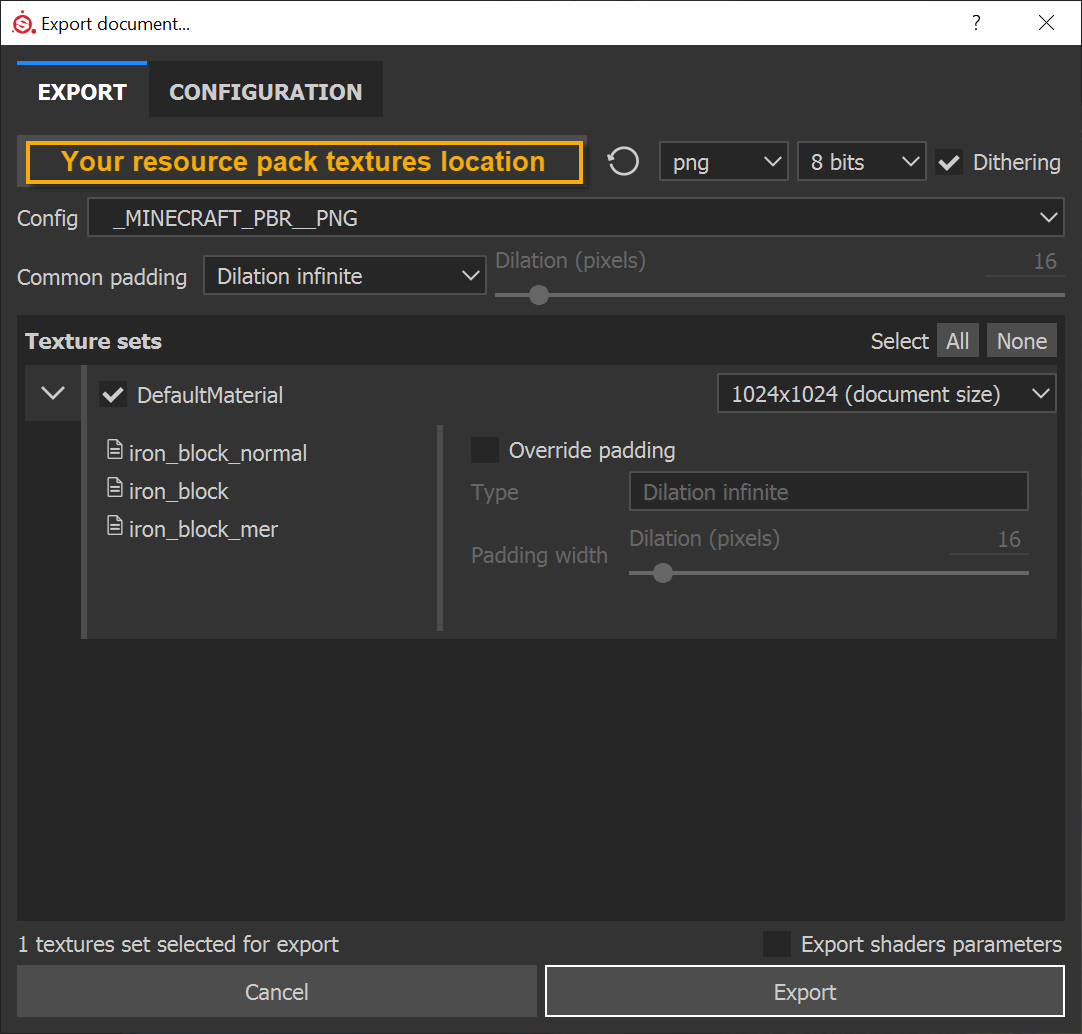
Notation: The instance higher up is for a fully opaque texture set. If you are using an opacity map in your texture set up listing for transparency, you will want to consign your base color map as a targa (.TGA) file (instead of a .PNG) with the opacity map being stored in the alpha channel.
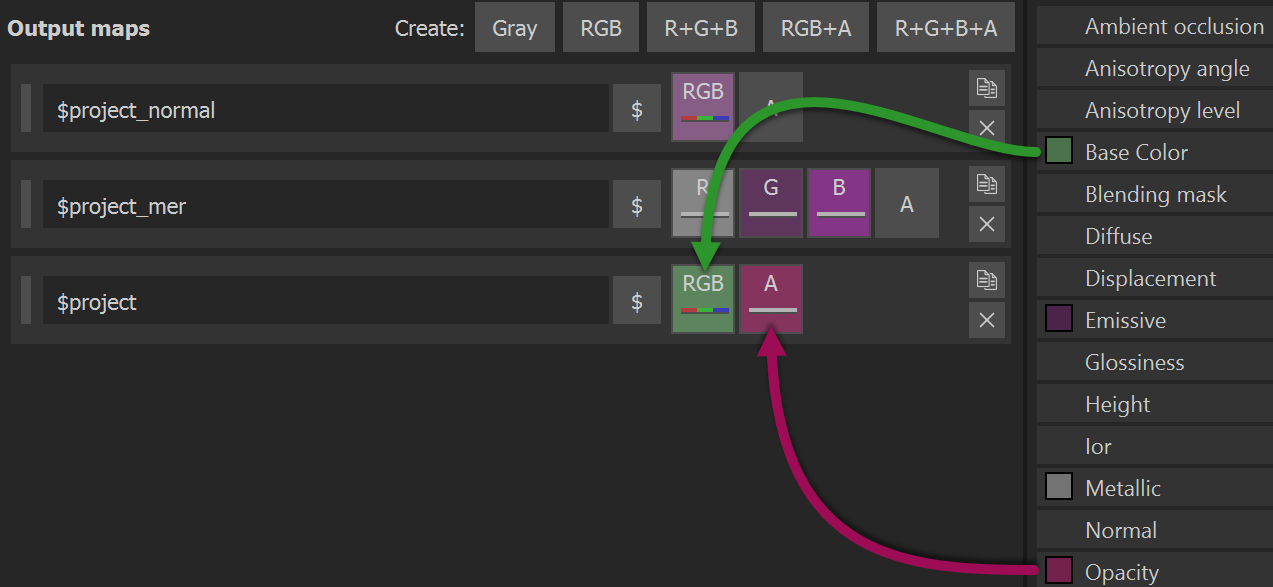
xix. Re-salve your projection! This volition save your export settings as well, which will make your workflow much faster as you practise further iterations with your texture set.
20. Finished! You have created your first set of HD PBR textures for Minecraft with RTX! Refer to the earlier sections, Resources Pack Setup and How to Test Your Textures in the Game, to observe instructions on how to view your new textures in the game.
Credit:
All textures were created with "Substance" the leading software solution for 3D digital materials.
https://www.substance3d.com/
@Substance3d
#MadeWithSubstance
#CreateWithSubstance
Customizing the Fog
On peak of prettifying textures with PBR enhancements, PBR-enhanced resource packs tin can also add custom fog definitions and employ them through the new fog stack (for further info, head to Minecraft.net). This fog stack is ordered past lowest priority to highest:
- Hardcoded Engine defaults
- Data Default settings from "default" object within biomes_client.json
- Per-Biome settings in biomes_client.json
- /fog Command
Both biomes_client.json and /fog Command refer to Fog Definitions which are defined in JSON with the "fog" binder of Resources Packs.
Fog Definitions
Each Fog Definition is a JSON file in the "fog" folder of a Resource Pack. An example looks like:
{
"format_version": "1.16.2100",
"minecraft:fog_settings": {
"clarification": { "identifier": "nvidia:example_fog" },
"altitude": {
"air": {
"fog_start": 0.92,
"fog_end": 1.0,
"fog_color": "#ABD2FF",
"render_distance_type": "render"
}
},
"volumetric": {
"max_density": {
"air": {
"max_density": 0.1,
"max_density_height": 56,
"zero_density_height": lxx
}
},
"media_coefficients": {
"air": {
"scattering": [ 0.02, 0.02, 0.02 ],
"assimilation": [ 0.0, 0.0, 0.0 ]
}
}
}
}
}
The schema for a Fog Definition.
- format_version: The schema version this JSON was written for.
- minecraft:fog_settings: An entry for the fog definition.
- Clarification
- identifier: A quoted unique name, prefixed with a namespace followed by a colon. The unique identifier is used to refer to a Fog Definition, e.g. from biomes_client.json and from the /fog Command.
- distance: An optional object containing settings for altitude fog that limits the thespian's view from seeing anything beyond a specific distance from their camera. Contains a grouping of one or more optional, enumerated objects:
- air: When the player'due south camera is in air.
- conditions: When the actor's camera is in air with active atmospheric condition (e.g. rain or snow).
- water: When the actor'south photographic camera is in h2o.
- lava: When the role player's photographic camera is in lava.
- lava_resistance: When the player's camera is in lava while nether the furnishings of the "Fire Resistance" buff.
- Each enumerated object has the following distance values:
- fog_start: Distance in units or percentage where the fog begins solidifying.
- fog_end: Distance in units or percentage where fog becomes fully opaque.
- render_distance_type: Either fixed or render:
- fixed : The distance values are units and practical every bit blocks from the role player's camera.
- render: The altitude values are percentages, in range of 0.0 to 1.0, and are multiplied against the client'southward return distance setting.
- fog_color: the colour of the fog as a square bracketed list of 3 values in the range of 0 to 255; or as a quoted hexadecimal RGB value following a pound sign.
- volumetric: An optional object containing settings for volumetric fog which is calculated as calorie-free passing through blocks:
- density: An optional object containing settings for pinnacle-based fog. Contains a group of i or more optional, enumerated objects:
- air: When the player's camera is in air.
- weather: When the player's photographic camera is in air with active atmospheric condition (e.g. pelting or snow).
- water: When the histrion'south camera is in water.
- lava: When the thespian'southward camera is in lava.
- lava_resistance: When the player'due south camera is in lava while under the effects of the "Fire Resistance" vitrify.
- Each enumerated object has the following density and tiptop values:
- max_density: A partial value to multiply the fog density. 0 will have zero fog and ane volition take completely opaque fog.
- compatible: A boolean value: faux scales the fog density based on depth into the enumerated medium and true makes the fog distribute evenly across height, ignoring the values of zero_density_height and max_density_height.
- zero_density_height: Height in blocks where the fog starts densifying. Ignored if compatible is true.
- max_density_height: Height in blocks where the fog stops densifying. Ignored if uniform is true.
- media_coefficients: An optional object containing settings for how light is dispersed and refracted by density fog equally rays travel through various mediums. Contains a group of ane or more optional, enumerated objects:
- air: used when calorie-free is passing through air.
- water: used when low-cal is passing through water.
- cloud: used when light is passing through clouds.
- Each enumerated object has the following coefficient settings:
- handful: A square bracketed list of three values for red, green, and blue colors to spread for the light passing through the enumerated medium. These values range betwixt 0.0 and 1.0. Information technology tin can also instead be a quoted hexadecimal RGB value following a pound sign.
- density: An optional object containing settings for pinnacle-based fog. Contains a group of i or more optional, enumerated objects:
- Clarification
absorption: A foursquare bracketed list of 3 values for red, greenish, and blue colors to absorb for the light passing through the enumerated medium. These values range between 0.0 and i.0. It can too instead be a quoted hexadecimal RGB value following a pound sign.
Biomes
The biome layer of the Agile Fog Stack is an average of settings from biomes around the player's position. Each biome, in biomes_client.json,may reference a Fog Definition by its unique identifier for applying biome specific fog settings.
Fog Command
The /fog Control tin can further manage which Fog Definitions are applied to the Active Fog Stack for each player.
Fog settings inside this layer of the stack are ordered via push, pop, & remove modes the /fog Control.
button: applies a fog definition, along with a user-provided ID, onto the top of the Fog Command layer(s) of the selected player(s).
pop: removes the top-most fog definition, from the selected player(south), that matches the user-provided ID (i.e. as provided previously via a /fog Command using the push button style).
remove : removes all fog definitions, from the selected player(due south), that matches the user-provided ID.
The state of players' Fog Command layer of the Active Fog Stack is saved and loaded for each thespian throughout play sessions of a globe.


Best Rtx Minecraft Texture Packs,
Source: https://www.nvidia.com/en-us/geforce/guides/minecraft-rtx-texturing-guide/
Posted by: teerfaloseention.blogspot.com
0 Response to "Best Rtx Minecraft Texture Packs"
Post a Comment